Defining the Moment - The Paintings of Thomas Kelly
By Daniel Shearer
The Sophistication of Simplicity
If a picture is worth a thousand words, then the paintings of Thomas Kelly may be the genesis of entire novels. His work is currently on display, along with that of five other members of the Trenton Artists Workshop Association, at Ellarslie, The Trenton City Museum.
Inspiration can come in unusual places. Not too long ago, a large Italian man unknowingly gave Trenton artist Thomas Kelly an idea for a great painting.
Seated at a restaurant in Florence, Italy, Mr. Kelly spent a pleasant hour enjoying his meal, eating good food and drinking even better wine. Still, Mr. Kelly didn't seem as happy as the big man seated at a table next to him. The stranger burst into song as a server carried an enormous steak to his table.
"It was a big guy, and he was ready to eat," Mr. Kelly says. "He wasn't shy about loving that steak. He was serenading it."
Although that particular painting hasn't taken shape yet, Mr. Kelly says the moment earned a place in an artistic memoir of sorts. He carries around anotebook of several hundred quick descriptions of people and situations in an attempt to capture those illusive creative thoughts before they're forgotten.
"Who knows where they'll come from," says Mr. Kelly, casually flipping through pages in his idea book. "Christ on a cactus, Christmas trees by the side of the road, you know, after everybody chucks them out on the curb - people sitting in a laundromat. It seems like I have more ideas than time.
The 35-year-old painter and printmaker is one of six contributors to the Trenton Artists Workshop Association invitational exhibition at the Trenton City Nuseum in Cadwalader Park which runs through Dec. 6. The show also includes work from landscape artist Paul Mordetsky, a series of floral paiting by Aundreta Wright and abstract acrylic paintings by Csilla Sadloch.
In addition, photographer Gary Saretsky provides numerous black and write prints taken during his travels in Italy, along with about a dozen Polaroid transfer photographs printed on watercolor paper. Artist Cindy Bearce-Maffini also displays several pastel and watercolor paintings inspired by her travels in France.
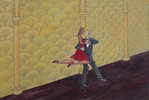
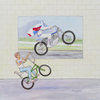
While his paintings cover a variety of subjects, Mr. Kelly says he's primarily interested in depicting the everyday life of people. On the surface, Mr. Kelly's bold use of color and cartoon-like style may seem simplistic, but the subtle touches in his work - like a crucifix casually placed on a dresser in the painting, "Back Home After Dinner" - give it a depth that may escape a veiwer's first glance.
"I always paint people," says Mr. Kelly. "It's what interests me. I'm not a slave to perspective or proportion. I don't like to work like that. They're simple on the outside, but really they're sophisticated because of the layering and the colors and the composition.
"They're misleadingly simple. This is just a little slice in time. People have to fill in what happened before this and what's going to happen after it. That's the part I like."
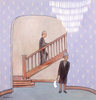
"Back Home After Dinner" gives viewers a unique perspective: a woman seated on a bed glances casually over her shoulder at a man deliberately painted outside the scene; her companion is visible only in a small mirror on a wall across the room.
"It's pretty interesting what people say about my work because it gives you insight into the person," he says, speaking of the woman in "Back Home After Dinner." "You see something positive, whereas someone else might see it as negative. Someone told me yesterday, 'She feels guilty. Look. The blinds are closed, the crucifix is off.'"
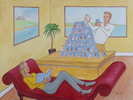
Each of Mr. Kelly's paitings tells a story. However, he doesn't feel that viewers should be limited to only one interpretation; his painting, "After the 41st Move," shows one seemingly perplexed individual leaning over a chess board, checkmate an inevitable one move away, while his competitor leans back reading a newspaper.
"I was tempted to go with no titles," he says. "People come up with fantastic stories. Sometimes their stories are better than mine. I use simple images that people can relate to. There's no high-brow intimidation going on here. I try to paint at a common level. I like the figures and what you can do with them, how people can construct a narrative when they see them.
"People want everything wrapped up in a tidy box. They don't get that with my paintings. They have to read into it."
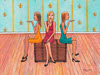
Most of Mr. Kelly's paintings include more than one person, and often, a pet looks on from somewhere in the scene, lending an additional fly-on-the-wall viewpoint. In "Toasting the Fish," a rather quirky couple with intoxicated smiles raise their glasses in a restaurant.
"Everybody's been there. You know, when they keep you waiting at a restaurant too long," he says. "You've had a few glasses of wine or a couple of drinks. And here they are, smarter than the fish, toasting. If you look in the background, everybody else is not as happy. But they're not eating."
After he gets an idea, Mr. Kelly says he'll sit down to do a "two-minute sketch" where he starts to hammer out content and composition. He hopes to some day quit his job - he currently works as a machinist for a medical vacuum pump company - and work as a full-time artist. The show is Mr. Kelly's first major exhibit.
"When I paint, I can loosen up and get away from the rigidity of technical problems," says Mr. Kelly, who started painting about five years ago. "Lately, I've been painting like a maniac.
"It started when I bought a house and had no money to decorate. I could always make stuff. I build furniture and it was just an evolution from there."
Stylistically, Hightstown resident Paul Mordetsky says he is also interested in exploring relationships but chooses to depict scenes observed by people. On some of his paintings, Mr. Mordetsky incorporates photocopied maps and diagrams that contribute to his work's overall composition.
"They're all fairly empty and barren," he says, of his work. "Though I've been to all of these places, and I've drawn there and photographed things there, I'm not particularly interested in places as real scenes. I'm interested in a certain quality of stillness, of silence, of alientation to a degree but not in the sense of making you not want to be in the landscape. It's a depopulated kind of barren, open quality, where one can kind of feel that this is a place to wander, to gaze, to make decisions."
His work, "An Older, Colder Voice," takes its name from a W.H. Auden poem. Using a semi-realistic style with subdued tones, the work depicts a desolate group of rocks along the Saguenay River in northern Quebec.
"I like these rocks because of their limited color," he says. "None of these are typical, lovely country scenes that one often associates with landscape painting.
"By an older colder voice, it actually comes from a section of a W.H.
Auden poem, that, if I can quote correctly, was, 'But the really reckless were
drawn by an older, colder voice, the oceanic whisper, which asks nothing and
promises nothing in return."