The Narrative Stance - Loring Hughes and Tom Kelly

The Gallery at Mercer County Community College - Through September 28

By F. R. Rivera

The pairing of Tom Kelly and Loring Hughes is as near perfect as it gets. Each artist navigates the choppy waters of social interaction. Both are painters of people - pampered people at the center of good times (Kelly); and survivors of the worst times, people on the remote fringe of society (Hughes). People are the players, but the real subject for both artists is the situation - people second guessing other people - and the work is totally absorbing.

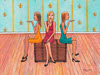
Each artist creates settings that are loaded with irony, such as Mr. Kelly's Ladies Room, or Ms. Hughes' chronically murky Six O'Clock News.

They both depict interaction (The Narrative Stance), but these two reconteurs lead us to very different places. The style of their figures differs fundamentally, as well. Mr. Kelly's are tall and rangy, whereas Ms. Hughes' are dwarfed and injured.

The two artists are equally dissimilar in their handling of paint, as well as in the media they employ. Mr. Kelly uses acrylic on canvas, while Ms. Hughes uses gouache, pen and ink, on paper. In a Yin-Yang sense, the juxtaposition of the two artists is irresistible. Kudos go to curator Tricia Fagan for her insightful match.

Ms. Hughes, born in 1957, is an unabashed new-expressionist. She acknowledges the influences of expresssionists, including Ensor, Posada, and Beckman. Whether for person or aesthetic reasons, the characters in her work are impaired. (She mentions in her biographical material that she has recovered from a rare neurological disorder.)

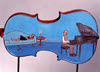
She uses fluid water-soluble media, cutting between line and mass, inviting spills, splatters, and runs. Her's is an intensely improvisational style, which does ot proceed from preliminary drawings; her characters are victims or in imminent danger of becoming victims. They warp and mutate, depending on the dictates of chance, i.e., Preacher Killing Snakes in My Backyard.

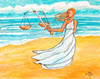
Like Mr. Kelly's, her figures are caricatures, whose proportions and physiognomy express inner demons. Frequently, their heads are inordinately large and earless; and their eyes are blackened. Ms. Hughes' compositions are embattled arenas, where outsized gesture rules. As in the Grand Guignol, hers is a place where chronic drubbing and insult are the rule; where comedy turns cruel.

In her work, the line between theater and reality blurs; questions abound. Do her characters grimace violently because they've just been stabbed, or are they just over-acting? In a piece entitled Serial Killer Beauty Contest, Ms. Hughes trots out the purveyors of evil and poses the question, "Who wins - knife, gun, or bludgeon?" She visually implies that her people are just so much disposable trash.

In Model of Perfection, for example, a discarded skeleton, long forgotten on the dump heap, is still wearing her green bikini. It is not just the shock of road kill that characterizes her work; like the German painter Otto Dis, Ms. Hughes is unrelenting in her exposure of discord.

Painter of Expectancy

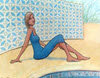
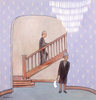
Tom Kelly, on the other hand, is sunny and clear, giving us a forecast of blue skies and puffy white clouds. Behind each cloud, however, is a bit of mischief about to occur. He is a painter of expectancy. Invariably, he captures that penetrating instant in a siaution, just before the denouement - like the tipping point before the applause (Tattoo People); before the surrender (Arm Wrestlers); or before the charge (Scared of Dogs).

Mr. Kelly paints air-tight situations that are about to pop a seam. There is just enough irony leavened in to make the outcome unpredictable, thus causing different viewers to predict different outcomes.

The characters who inhabit Mr. Kelly's world are about his age. (He was born in 1963.) Being older than Gen. Xers and just shy of Boomers, these characters are the pampered generation, slightly confused by being jettisoned into an endless weekend where they are surrounded by others exactly like themselves. They are in a place where pleasure and leisure are spreading out in every direction.

Like the painter Balthus, whom Mr. Kelly cites as a visual mentor, his figures strike telling poses; they bend and sway or go contraposto (twist like pretzels). Their body language is so ordered and clear that when they signal one another, it is with the precision of a semaphoric code.

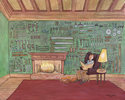
In a number of canvases, Mr. Kelly's figures cluster in social groups, as in Map Room. They are painted in a flat, cut-out style, like the figures of Alex Katz, in which subtle shading transforms uniform areas of color. Small dollops of acrylic are scumbled into the backgrounds, giving them the look and feel of stage sets and scenery.

In a piece entitled She Likes Them Tall, two seated females, each dressed in vampish red, are in the midst of a cocktail party. They have positioned themselves in such a way as to suggest a territorial imperative. The quarry, a man standing behind one of the woman is about to succumb - but to whom?

A large canvas entitled The Doubting Thomases, portrays four young men - who look for all the world like graduate students on a field assignment - as they poke, sniff, and otherwise inspect the wounds of a submissive Christ.